Friday, August 28, 2020

Lyon, France Culinary Capital of the World, Part II, Some current French Chefs


Current French Master Chef's mentioned in Bill Buford's books

1933  Michel Guérard (born 27 March 1933) is a French chef, author, one of the founders of nouvelle cuisine, and the inventor of cuisine minceur.  Cuisine minceur is a style of cooking created by French chef Michel Guérard, which recreated lighter versions of traditional nouvelle cuisine dishes. Critics acknowledged that the minceur versions by Guérard tasted better and were less filling than their nouvelle cuisine originals.  Last September one of the dinners I had with him featured 3 courses all made with vegetables that were exquisite and filling and a huge surprise. Guérard served his apprenticeship at the patisserie of Kleber Alix, in Mantes-La-Jolie. He worked at a number of Parisian restaurants, including Maxim's, and in 1958 won the Meilleur Ouvrier de France Patisserie, while working as a pastry chef at the Hôtel de Crillon. He also worked at Le Lido.  In 1965 Guérard opened a restaurant in Paris called Le Pot-au-Feu, which in 1967 earned Guérard his first star in the Michelin Guide. The restaurant gained a second star in 1971 and was successful until it was compulsorily acquired for the purposes of a road-widening.  In 1972 Guérard met Christine Barthelemy, the daughter of the founder of the Biotherm range and the owner of a chain of spas and hotels. They married, and in 1974 he moved with her to Eugénie-Les-Bains, where she was running one of her family's smaller, less successful spas. They restored the buildings, and Guérard invented a style of food, cuisine minceur, a form of healthy cooking, designed to lure health-conscious Parisians to travel the 800 km to Eugénie. In 1977 his main restaurant received three Michelin stars, and all his properties in Eugénie have been very successful, transforming the tiny village into a significant tourist destination.  In 1983 Christine and Michel purchased the Château de Bachen, replanting the vineyards, and producing their first harvest in 1988. Christine and Michel Guérard currently own three restaurants in Eugénie-Les-Bains:  Les Prés d'Eugénie. Part of the main spa hotel, this restaurant serves cuisine gourmand and has since 1977 received three stars in the Michelin Guide.  Having been there in September 2019 I can confirm it is heaven on earth.  
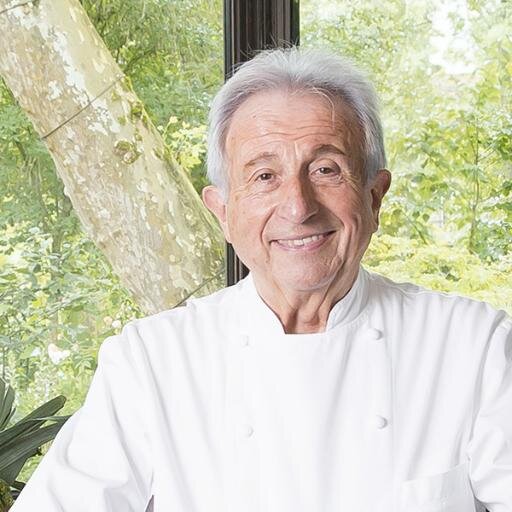

Chef Michel Guerard

1948 Michel Rostang was born in 1948 to a restaurant family in Pont de Beauvoisin, France. His father, Jo, owned and operated La Bonne Auberge in Antibes, on the French Riviera. Michel went to hotel school in Nice, apprenticed in the family restaurant in Sassenage (near Grenoble), Laporte in Biarritz, Lasserre, La Maree, and Lucas Carton in Paris, and returned to his family’s two Michelin star restaurant in 1973. In 1978 he left and opened Michel Rostang’s (now Maison Rostang) in Paris and received his first Michelin star a year later, and a second one the following year in 1980. In 1987 he started opening a chain of baby bistrots, four through 1993, and three other restaurants (L’Absinthe, Dessirier, and Rue Balzac) through 2000. In May of 2000, the Great Chefs television team returned to Paris from Lyon, and taped Chef Michel Rostang for their Great Chefs of the World television series for the Discovery Channel. While taping, Great Chef Jean Paul Lacombe, whom the television crew had just recorded earlier in the week in Lyon, showed up to give his support to Chef Rostang 

Chef Michel Rostang


1949 Jean-Paul Lacombe (b. 1949) who currently owns Leon de Lyon is perfection, a succession of beautifully appointed intimate dining rooms which are the stage for chef Jean-Paul Lacombe as he creates his perfectly prepared dishes. The chef, the place, the food, all illustrate his nation’s culinary heritage. The personal history of Lacombe is intertwined with his family’s restaurant. Léon de Lyon harks back to 1904, a fact that is evident in its beautiful antiques and stained glass windows. This celebrated restaurant, the best in the very heart of France, became part of the Lacombe family in 1949. In 1955 it won its first Michelin star. When Paul Lacombe passed away in 1972, his wife, son, and daughter took over the reins. In 1978 Léon de Lyon won its second Michelin star; in 1981 it was selected by Gault Millau. In 1985 the restaurant was admitted to the Chaîne des Relais et Châteaux. By 1987, enthusiastic diners and critical acclaim brought admission to the Chambre Syndicale de la Haute Cuisine Française, and in 1995 to Traditions et Qualité, Les Grandes Tables du Monde. Lacombe creates dishes which draw on Lyonnaise cuisine and use local products, changing the menu with the seasons. Great Chefs caught up with Jean-Paul in September of 1998 to film four dishes for their Great Chefs of the World series and Great Chefs of France series: Praline Tart with Praline Ice Cream; Suckling Pig Foie Gras Terrine; Pike Dumplings; and Potato Stuffed with Pig’s Feet, Foie Gras, Truffles and Mushrooms. While filming, his personal friend, Chef Michel Rostang of Restaurant Michel, showed up to watch. We had just filmed Chef Rostang the day before. Host to Presidents, Great Chef Lacombe and his Chef du Cuisine, Guy Labonde, continue to perfect his art, updating traditional dishes for contemporary palates. 

Chef Jean-Paul Lacombe

1950 Marc Veyrat loved and loathed as the craziest chef in France (born 8 May 1950) is a French chef from the Haute-Savoie region, who specialises in molecular gastronomy and the use of mountain plants and herbs. Veyrat has obtained a total of nine Michelin Stars and is the first cook to get the perfect grade of 20/20 in the Gault et Millau guide for each of his two first restaurants. He was the owner of the restaurants La Maison de Marc Veyrat (or l'Auberge de l'Eridan) in Veyrier-du-Lac and la Ferme de mon Père in Megève. He currently operates the restaurant La Maison des Bois in Manigod. All three restaurants obtained three stars. In 2019, Veyrat was awarded two Michelin Stars for La Maison des Bois, and is suing Michelin saying that the loss of one star was a miscommunication On 24 February 2009, he announced that he would cease all of his activities at la Maison de Marc Veyrat due to his declining health. The hotel is currently being run by his children. He started a chain of organic "fast-food" restaurants all over France called la Cozna Vera. The first one opened in Annecy in 2008 and was later closed in 2010. He has plans to build other restaurants in Épagny, Brussels, and Paris. 


Chef Marc Veyrat

1967 Mathieu Vianny chef of reopened La Mere Brazier first owned by Eugenie Brazier (b. 1967, at Versailles). Viannay opened a first restaurant in Lyon, in 1988 Les Oliviers. This restaurant was replaced in 2001 by his new restaurant named rosemary juice that was awarded a one star Michelin in 2005. In the meantime, in 2004 Mathieu Viannay became Meilleur Ouvrier de France. In March 2008, he bought the historic restaurant of La Mère Brazier, located at rue Royale at the intersection with rue Eugenie Brazier, whose operation was effective in October of the same year This restaurant accesses the second star in the Michelin , in March 2009. 

Chef Mathieu Viannay


1969 Anne-Sophie Pic (born 12 July 1969) is a French chef best known for gaining three Michelin stars for her restaurant, Maison Pic, in southeast France. She is the fourth female chef to win three Michelin stars, and was named the Best Female in 2011. Anne-Sophie Pic was born in Valence, Drôme, in France on 12 July 1969. She is the daughter of chef Jacques Pic, and grew up at her family's restaurant, Maison Pic. Her grandfather, Andre Pic, was also a chef, who was particularly known for a crayfish gratin dish, and who first gained the restaurant three Michelin stars in 1934. She initially decided not to follow in their footsteps, and instead travelled overseas to train in management. She worked in Japan and the United States as an intern for various companies, including Cartier and Moët & Chandon, but found herself drawn back to the restaurant for her "passion". In 1992, at the age of 23, she returned to Maison Pic to train under her father to become a chef. He died three months later, and she moved to working the front of the house. In 1995, the restaurant lost its third Michelin star, for which she felt she had lost "her father's star", and spurred her to return to the kitchen. In 1997, Pic took control of the restaurant. She had no formal training in cooking. In 2007, she regained Maison Pic's three Michelin stars. This was only the fourth time ever that a female chef had achieved three Michelin stars. That same year, Pic was the only woman on French newspaper Le Figaro's list of the top twenty richest chefs in France. She opened her second restaurant, Restaurant Anne-Sophie Pic, in Lausanne, Switzerland. It was awarded two Michelin stars in 2009, and is located within the Beau-Rivage Palace hotel. In September 2012, she opened her first Paris-based restaurant, La Dame de Pic.

Chef Anne-Sophia Pic

Lyon, France the Culinary Capital of the World Part I with American Chefs

Bill Buford spent many years in Italy and Lyon, France learning firsthand both Italian and French cuisine. His philosophy as a writer was that to truly accurately write about something you loved you needed to be in the arena participating at the front lines so to speak in order to fully understand what you were writing about. As a result he worked as an amateur cook in many restaurants as well as working in a butcher shop. The result was two books "Heat" and "Dirt". "Dirt" describes his experiences in France and I have organized the chefs he mentions here and I recommend you review articles about them on the internet. I will present in my next article the ancient Chef's of the past long gone in date order as reading the books can be confusing as to who is who and who did what. In the end French cuisine has evolved over hundreds of years bringing us to the here and now. In many ways because of the evolution of French cuisine we can all enjoy it now and with Mr. Buford's books understand it better. It took a while but I also found a You Tube series, "Fat Man in a White Hat" on the internet from 2004 where you can see first hand many of these chefs and dishes mentioned in the book. The link is to the first 20 minute video and if you just let it run it will automatically go onto the next 20 minute video and there are 8 videos. The first link is here: 


Maurice Edmond Saillard, the French wine writer known as "Curnonsky" was the first person who wrote "Lyon, the Gastronomic Capital of the World" Lyon is the Ville des Meres, the city of the mothers, the mere chefs. Having been to Lyon I can verify the statement as true and Mr. Buford's book clearly supports this statement. Fortunately this cuisine has been exported to the world so I start with two famous American chefs who sadly have passed on and one still living, who brought the best in French cuisine to the USA and I recommend you read about them also. In my opinion what they did was elevate French Novelle Cuisine to a level better appreciated and understood by American consumers and making a statement that "yes, French food is that good!" I consider Julia Childs and Jacques Pepin traditionalist who showcase French Classical cuisine but my goal here is to elevate and celebrate French Novelle Cuisine as the current gold standard in French cookery and more specifically Lyon, France Cuisine. This is the first of three articles. 


Maurice Edmond Saillard "Curnonsky"

American Chefs who celebrated French Cuisine in the USA 

1949 Dorothy Cann Hamilton(1949-2016) French founder of the International Culinary Institute and author of "The Fundamental Techniques of Classic Cuisine" She was also president of the Friends of the USA Pavilion for Expo Milano 2015. WomanzWorld described her as "one of the most influential forces shaping the American culinary landscape today". She tragically died in an auto accident in 2016. 


Chef Dorothy Cann Hamilton

1948 Michel Louis-Marie Richard (1948 – 2016) was a French-born chef, formerly the owner of the restaurant Citrus in Los Angeles and Citronelle and Central in Washington, D.C. He has owned restaurants in Santa Barbara, Tokyo, Carmel, New York City, Atlantic City, Las Vegas, and Washington, DC. Richard was born in Pabu, Brittany, France on March 7, 1948 and raised in Champagne. Needing to help his mother care for his siblings, he learned to cook. By age 14, Richard was working full-time as an apprentice pâtissier at a hotel restaurant in Reims. After completing his military service as a cook in the French Army, he moved to Paris, where he was hired by French pastry chef Gaston Lenôtre at Maison Lenotre He was the author of "Michel Richard's Home Cooking with a French Accent" his famous Opus 1. We met Richard at the Festival of Fine Wine and Food at the Tyson's Corner Ritz Carlton in January of 2003. The very first dish he served us was raw eel cappacio. Served on a plate the eel looked like gray rose flowers and was very artistic. Years later we learned his technique using frozen rolls of food sliced thin with a meat slicer. The eel smelled up the room and 90% of the guests refused to eat it. But when you took a sip of Champagne and ate the eel the combination was spiritual proving wine improves food and food improves wine when done correctly. Over the years we had dinner twice at Citronelle and the dinners were again innovative and spectacular. Sadly Michele died from a stroke in 2016. 


Ross & Clark with Michel, It was an honor to know him

1955 Daniel Boulud (born 25 March 1955 in Saint-Pierre-de-Chandieu) is a French chef and restaurateur with restaurants in New York City, Boston, Washington, D.C., Palm Beach, Miami, Toronto, Montréal, London, and Singapore. He is best known for the eponymously named restaurant Daniel, in New York City, which has two Michelin stars. While raised on a farm outside of Lyon and trained by a variety of French chefs, Boulud made his reputation in New York, first as a chef and most recently a restaurateur. His management company, The Dinex Group, currently includes fifteen restaurants, three locations of a gourmet grocery (Epicerie Boulud), and Feast & Fêtes Catering. His restaurants include Daniel, Café Boulud, db bistro moderne, Bar Boulud, DBGB Kitchen & Bar, and Boulud Sud. At fifteen, Boulud earned his first professional recognition as a finalist in France's competition for Best Culinary Apprentice. Boulud worked in France with Roger Vergé, Georges Blanc and Michel Guérard and later in Copenhagen before becoming the private chef to the European Commission in Washington, D.C. After moving to New York City, Boulud opened the Polo Lounge at The Westbury Hotel, followed by Le Régence at the Hotel Plaza Athenée. From 1986 to 1992, he was a critically acclaimed executive chef at Le Cirque. I had dinner at his new place at Wynn Hotel in Las Vegas where I had his famous foie gras hamburger which was basically a high-end hamburger with a chunk of foie gras in the middle. Highly over the top!

Chef Daniel Boulud

1957 Jean George Vongerichten born 16 March 1957) is a French-American chef. Vongerichten commands restaurants in Miami, Las Vegas, London, Paris, Shanghai, and Tokyo, as well as New York's Jean-Georges restaurant and Tangará Jean Georges in São Paulo's luxurious Palácio Tangará, by Oetker Collection. He is also the head chef of Eden Rock, St Barths. Vongerichten is the author of five cookbooks, two with Mark Bittman. Born and raised on the outskirts of Strasbourg in Alsace, France, Vongerichten's earliest family memories are about food. The Vongerichten home centered around the kitchen, where each day his mother and grandmother would prepare lunch for almost 50 employees in their family-owned business. His love for food cemented his choice of career at the age of 16, when his parents brought him to the 3-star Michelin-rated Auberge de l’Ill for a birthday dinner. Vongerichten began his training soon after in a work-study program at the Auberge de l'Ill as an apprentice to Chef Paul Haeberlin. He went on to work with the top chefs in France, including Paul Bocuse and Louis Outhier at L’Oasis in the south of France. Often working with Outhier, Vongerichten opened 10 restaurants around the world from 1980 to 1985, including the Oriental Hotel in Bangkok, the Meridien Hotel in Singapore, and the Mandarin Hotel in Hong Kong. Vongerichten arrived in the United States in 1985 under the auspices of consulting chef Louis Outhier, opening the Le Marquis de Lafayette restaurant in Boston. A year later he arrived in New York to take over the executive Chef position at Lafayette in the Drake Swissôtel, generating critical acclaim with his innovative interpretation of classical French cuisine and earning four stars from The New York Times at the age of 29. There he met financiers Bob Giraldi and Phil Suarez, a loyal dining patron. Vongerichten, Giraldi and Suarez opened a bistro, JoJo, in 1991. JoJo was named Best New Restaurant of the Year, and earned three stars from The New York Times, in which Food critic Ruth Reichl claimed: "His food took my breath away". Jean George's cuisine is very accessible at the Trump Tower at 1 Central Park West in New York City. He serves a 3-course lunch for a reasonable price and serves many of his famous dishes there. I have eaten there many times and highly recommend it when you are in New York City.

Chef Jean George Vongerichten

Wednesday, July 29, 2020

Homemade Soups

Continuing to stay home and cook is opening doors for fine cuisine I never thought I could do. Over the past week we have made Italian Minestrone as well as New Orleans Okra Gumbo, two of my favorites. Turns out essentially all soups and maybe even stews start out with a mirepoix (/mɪərˈpwɑː/ meer-PWAH; French pronunciation: ​[miʁˈpwa]) which is a flavor base made from cooked, diced vegetables, usually with butter, oil, or other fat, for a long time on a low heat without coloring or browning, as further cooking, often with the addition of tomato purée, creates a darkened brown mixture called pincage (French: pinçage). In the South, for hundreds of years the fat that has been used is fat back, hamhock, or salt pork, and in New Orleans with the French flair, Lardons which is glorified bacon. So most of the time I use bacon and/or sausage. It is not sautéed or otherwise hard cooked, because the intention is to sweeten the ingredients rather than caramelize them. It is a long-standing cooking technique in French cuisine. I also add heavy doses of garlic as I love garlic but garlic is added later as you can burn it if you cook it long enough. 

When the mirepoix is not precooked, the constituent vegetables may be cut to a larger size, depending on the overall cooking time for the dish. Usually the vegetable mixture is onions, carrots, and celery (either common 'pascal' celery or celeriac), with the traditional ratio being 2:1:1, two parts onion, one part carrot, and one part celery.[1] Mirepoix is the flavor base for a wide variety of Western dishes: stocks, soups, stews and sauces

Similar flavor bases include the Italian soffritto, the Spanish and Portuguese sofrito/refogado (braised onions, garlic and tomato), as well as the Turkish variation with tomato paste instead of fresh tomato of the eastern Mediterranean/Balkan region, the German Suppengrün (leeks, carrots and celeriac), the Polish włoszczyzna (leeks, carrots, celery root and parsley root), the Russian/Ukrainian smazhennya or zazharka (onion, carrot and possibly celery, beets or pepper), the United States Cajun/Creole holy trinity (onions, celery, and bell peppers), and possibly the French duxelles (mushrooms and often onion or shallot and herbs, reduced to a paste). 

It really is quite simple and after you have prepared the above you then add further ingredients dependent on what kind of soup you want. For Minestrone the basic addition is Herbs of Provence, diced potatoes, something green, kale, spinach, cabbage, and cooked/washed beans of some kind, and add a cheese rind for further flavor. For Gumbo add Gumbo seasonings and/or home cooked Roux("fried" flour in butter) okra, sausage, shrimp, and/or chicken. And the list goes on and on. YouTube has hundreds of 15 minute or less tutorials dependent on what interests you. Freezing a quart for a rainy days lasts for 3 or 4 months and my experience is the longer you simmer it the better and the second day out of the refrigerator warmed up is even better. 

Updated Covid-19 Recommendations from CDC

 I have included update recommendations from the CDC issued today. We all need to fully comprehend that as each day passes we learn more and more about this virus. I am witnessing lots of people totally misunderstanding this virus and as a result, it is close to spreading out of control. I can assure you the following is accurate: 

1. COVID-19 is HIGHLY contagious and is being spread exponentially primarily by large crowds of people partying not social distancing and not wearing masks. Physicians are just as bad as the general population. This week close to 1/2 of the Anesthesia physicians in a hospital tested positive after an evening party in one of their homes. Talk about not leading by example. You continue to hear about the "R" value which is an indication of the AVERAGE number of people ONE person can infect. My estimation is that it eventually will be calculated at over 10. Seasonal flu is 1 or less. So COVID-19 to me is at least 10X more contagious than seasonal flu. The virus is contagious the first 14 days you have it, after 14 days for the most part people no longer spread it. That is normal and consistent with most viruses that are spread with the initial exposure and COVID-19 is no different from most viruses in that you are spreading them before you know you have them. Once you are sick, you generally no longer are infectious but even that is not 100% dependent on the virus. Ebola for example spreads from dead bodies days after death. 

2. The death rate for seasonal flu hovers around at about 0.2% of the population. As of yesterday the death rate for the USA as a whole was 7% and for Florida was 1.4%. So COVID-19's death rate even with the best-case scenario in Florida is 7X the seasonal flu. 

3. MASKS AND SOCIAL DISTANCING WORK PERIOD. There should be no discussion regarding this. I previously reported studies that said if only 60% of the population wore a mask in public and followed social distancing the virus would go away in weeks. In my opinion, if 100% of the public wore masks and conformed to social distancing the virus would be gone in two weeks. Italy for one has clearly proven it works. Yesterday there were only 5 deaths in Italy. Medical N95 masks are the best but truthfully any mask helps and is better than nothing. Masks, including N95, are now available online at reasonable costs. Seems like everyone is making them now. 

Updated CDC recommendations based on new data are here: 

Patients with confirmed SARS-CoV-2 infection DO NOT need to have two negative tests at least 24 hours apart to return to work, school, or receive medical care. CDC has reported that COVID-19 cases can continue to test positive for up to 12 weeks after their initial positive test, but that they are only potentially infectious to others for about 10 days. 

As such, for most individuals with COVID-19 illness, isolation can be discontinued 10 days after symptom onset and resolution of fever for at least 24 hours, without the use of fever-reducing medications, and with the improvement of symptoms (changed from "improvement in respiratory symptoms" to address expanding list of symptoms associated with COVID-19). 

The decision to discontinue isolation for patients with confirmed SARS-CoV-2 infection should be made using a symptom-based strategy, not additional testing: 

· Individuals who had a mild or moderate illness and are not severely immunocompromised can return to work after: 

o At least 10 days have passed since symptoms first appeared and 

o At least 24 hours have passed since last fever without the use of fever-reducing medications and 

o Symptoms (e.g., cough, shortness of breath) have improved 

· Individuals who had severe to critical illness or who are severely immunocompromised can return to work after: 

o At least 20 days have passed since symptoms first appeared 

o At least 24 hours have passed since last fever without the use of fever-reducing medications and 

o Symptoms (e.g., cough, shortness of breath) have improved 

Asymptomatic persons with confirmed COVID-19: 

· Who are not severely immunocompromised can return to work after 

o At least 10 days have passed since the positive laboratory test and the person remains asymptomatic 

· Who are severely immunocompromised can return to work after 

o At least 20 days have passed since the positive laboratory test and the person remains asymptomatic 

o Asymptomatic persons who test positive and later develop symptoms should follow the guidance for symptomatic persons above. 

Definitions of mild to moderate and severe illness, and of severe immunocompromise, as well as more information about the science behind the symptom-based return to work can be found at: https://www.cdc.gov/coronavirus/2019-ncov/community/strategy-discontinue-isolation.html

Please note, the recommendation of 10 days is specifically for those who test positive for the coronavirus and have self-isolated. It does not apply to people who need to quarantine to keep from potentially spreading the virus. The incubation period for the virus is 14 days, so anyone who has been exposed to the virus still needs to quarantine and monitor for symptoms.

Sunday, July 26, 2020

How to make some Dough during the pandemic

M. Scott Peck published "The Road Less Traveled" in 1978.  The first line is "Life is difficult".  In the next 20 or so years, Dr. Peck wrote multiple other books developing a philosophy of life that speaks to living a full life with an emphasis on personal growth and many people agree as well as disagree with his philosophies.  In the end, he did not himself follow his own advice.  I bring him up here because one of his comments has guided me for years and it is this.  Like Dr. Peck, I have little to no mechanical abilities and frequently need to hire experts to do "Honey do" handyman jobs around the house as I seem to have no talent for it.  Even though I cook the same could also be said regarding my culinary abilities as my wife will let you know I am very messy and disorganized in the Kitchen.  Dr. Peck addressed this in his books admitting also to a lack of mechanical skills.  But he went on to discuss that was not really true for anyone.  What he discovered was that a lack of mechanical skills, or in my opinion, a lack of culinary skills is all about a lack of patience.  I have discovered the same during the pandemic.  When it comes to cooking or fixing things in truth I have no patience.  I want it fixed now, I want it done now, are we there yet?  The pandemic has given me the time to really get into cooking and understanding excellent food preparation and good cooking requires patience.  You cannot rush it.  When a recipe says to put the food aside to rise or rest there is a valid scientific chemical reason for it and if you rush the process it simply will not work and your food will be mush. 

 For the past 3 months, Clark and I have evolved our cooking and food preparation and have learned a lot.  We would like to pass on some of our new knowledge to you and as my blog is also about food, why not do this?  We have in fact found some valid short cuts that make food preparation easier and are able to open new doors to prepare foods you might not think you could ever do.  At the same time, I will emphasize those steps that do in fact require patience where you need to slow down, smell the roses, and let chemistry do the work it is intended to do.  For the first time in my life these past few months, I have now made homemade bread, biscuits, pizza dough/pizza, and pasta.  Dependent on what you want to make this lesson #1 is all about flour, water, and eggs, the basic ingredients of any dough.

 Up until the Renaissance, all bread products and pasta were made with water mixed with flour.  Somewhere after the 1600s or 1700s eggs were substituted for water and/or added to water.  In general, simple dough is flour and water.  You can find a lot of information regarding what flour is best for what purpose.  Suffice to say at home so far we have used generic all-purpose flour and so far everything has turned out well.  What we have discovered however is the ratio of solids to liquids in making dough is important.  Important enough to where we always measure now the ingredients. 

 Lesson # 1 300 grams of flour mixed with 180 grams of liquid, water, eggs, or water egg combination easily makes a dough ball that is easy to handle and then knead.  Obviously water weighs more than flour so if you mix based on the liquid volume the amount of water and flour as close to the same ballpark but you can look up the conversion.

 Lesson #2 mix any and all flour and any additional solids like salt for example in a food processor and then slowly add the liquid while the food processor is on.  In a very short time, it will make an obvious dough ball.  It is helpful to let the dough ball rest for a minute or two and then restart the food processor and do that 2 or 3 times.  You then remove the dough ball from the processor and it will be sticky but trust me it will be less sticky than if you started out using your hands to mix the flour and liquids. 

 Lesson #3 you do have to knead the dough ball and that is done by putting some flour on a counter to dry the outside of the dough ball a little so it reduces sticking to your hands and then fold and refold the dough ball onto itself.  You do this until the dough ball is smooth to the touch.  Almost every reference we looked at said you can never knead the dough too much.  But in general the best references we found said knead for at least 8 minutes and for all our recipes it worked out fine.

 Lesson #4 here comes the patience part.  After you finish kneading let the dough ball rest.  You just folded it and in a sense beat the crap out of it, it needs time to recover.  Every reference says it needs to rest for 30 minutes minimum.  You either put it in a bowl covered with plastic wrap or just wrap it in plastic wrap, either works.  We just made pizza dough last night and let it rest overnight with no problems.

 At this point, you can make whatever you are making and start cooking.  You cut the dough ball into a size that will meet your needs and the remainder can be wrapped in plastic wrap and frozen in the freezer where it can stay for around 3 months.  You can also put it in the refrigerator to use in the next 4 or 5 days.

 Those are the basics and so far to me easy to follow.  I do recommend you review a few YouTube videos to see how others do it and find the one that works best for you.  With anything, there is a learning curve but it took me only 2 or 3 tries to feel comfortable making anything and I hope it works out well for you.  We now make our own homemade pizza and it has been as good as delivery.  My next article will be making basic soups.


Wednesday, July 15, 2020

An Update on my Covid-19 Viral Load Article

I am providing in full an article just published that emphasizes why my previous article on viral load is so important. Bottom line the more virus you are exposed to and have in your bloodstream the greater the risk of death. As we speak the recommended behaviors of wearing a mask, social distancing, staying away from crowds, staying our of confined crowded spaces are all designed expressly for the purpose of reducing your exposure and hence your viral load. Why people will not follow these guidelines is beyond me.


Jul 8, 2020

SARS-CoV-2 Viral Load in Hospitalised Patients Correlates With Risk of Intubation, Mortality
By Denise Baez

Severe acute respiratory syndrome coronavirus 2 (SARS-CoV-2) viral load among hospitalized patients is independently associated with the risk of intubation and in-hospital mortality, according to a study published in Clinical Infectious Diseases.

Reed Magleby, MD, NewYork-Presbyterian Hospital, Weill Cornell Medical Center, New York, New York, and colleagues evaluated 678 hospitalized patients with coronavirus disease 2019 (COVID-19) and found that 35% of patients with a high SARS-CoV-2 viral load on admission died, compared with 17.6% of patients with medium viral loads and 6.2% of patients with low viral loads.

The findings suggest that using cycle threshold (Ct) values, which are available when results from reverse transcription-polymerase chain reaction (RT-PCR) assays are reported to clinicians, could identify patients at the highest risk of intubation and death and guide treatment accordingly.

“We found that admission SARS-CoV-2 viral loads, as determined by Ct values that are generated with standard-of-care diagnostic assays, are independently associated with intubation and death among hospitalized patients with COVID-19,” the authors wrote. “These findings highlight the critical role of viral load in SARS-CoV-2 pathogenesis and suggest that Ct values should be reported to assist clinicians in identifying patients at high risk for adverse COVID-19-related outcomes.”

Dr. Magleby and colleagues analyzed data from 678 patients who were hospitalized with COVID-19 between March 30, 2020, and April 30, 2020, at 2 hospitals in New York City. SARS-CoV-2 viral load was assessed using a cycle threshold (Ct) values from a reverse transcription-polymerase chain reaction assay applied to nasopharyngeal swab samples.

In-hospital mortality was 35% among the 220 patients with a high viral load (Ct <25), 17.6% among the 216 with a medium viral load (Ct 25-30), and 6.2% among the 242 patients with a low viral load (Ct>30). The risk of intubation was also higher in patients with a high viral load (29.1%), compared with those with a medium (20.8%) or low viral load (14.9%).

In a multivariate model that adjusted for age, race, coronary artery disease, congestive heart failure, cerebrovascular disease, hypertension, chronic obstructive pulmonary disease, days of symptoms prior to admission, symptoms upon presentation, initial chest x-ray findings, and level of oxygen support within three hours of arrival to the emergency department, having a high viral load was independently associated with increased risk of in-hospital mortality (adjusted odds ratio [aOR] = 6.05; 95% confidence interval [CI], 2.92-12.52; P< .001) compared with having a low viral load.

The risk of in-hospital mortality was also higher in patients with a medium viral load compared with a low viral load, but this association was not statistically significant (aOR = 2.06; 95% CI, 0.98-4.34; P = .058).

Compared with those with a low viral load, having a high viral load was also independently associated with increased risk of intubation (aOR = 2.73; 95% CI, 1.68-4.44; P < .001). The risk of intubation associated with a medium viral load did not reach statistical significance (aOR = 1.59; 95% CI, 0.96-2.63; P = .07).

Higher viral load was associated with increased age, comorbidities, smoking status, and recent chemotherapy. Patients with higher viral loads were also more likely to develop myocardial infarction, congestive heart failure, and acute kidney injury requiring hemodialysis.

“While prior studies indicated that viral load correlates with severity of COVID-19 presentation, our study of a larger cohort of hospitalized patients adds to this knowledge base by identifying that admission viral load has important prognostic implications,” the authors wrote. “Reporting
SARS-CoV-2 viral load based on Ct values from admission NP swab samples could, therefore, help identify patients who are at the highest risk of adverse outcomes and who therefore may benefit from more intensive monitoring. Identifying high viral load patients could also be helpful for allocating scarce therapeutic interventions such as antiviral agents.”

The authors noted that additional studies that evaluate viral loads and clinical outcomes among all patients who present to the emergency department are warranted prior to pursuing this strategy clinically.

Reference: https://academic.oup.com/cid/article-pdf/doi/10.1093/cid/ciaa851/33448916/ciaa851.pdf

SOURCE: Clinical Infectious Diseases

Sunday, July 12, 2020

Cooking with an Air Fryer

Like everyone else, I am sitting around all day looking for things to do to break the boredom. On TV for a significant portion of my life, I have been bombarded with "infomercials" telling me about the latest and greatest home device that will save me millions of money and minutes of time. On occasion, I succumb to the pressure and buy something. Over the past few years with the advent of Amazon I have developed the habit of looking at online reviews before I buy anything. To my amazement over 90% of the things, I look up to turn out to have a high percentage of negative reviews in which case I don't buy the product, so the actual products I buy are minimal. 

Having all this time on my hands has led me to cook more and a larger variety of foods at home and usually I make a big mess as I am a messy cook. Being from the South I love beyond logic fried foods, especially fried chicken and French fries. So why not try those great foods. Alton Brown has a YouTube video on making fried chicken that seemed simple enough. Unfortunately, it takes quite a lot of time and when it was all said and done the kitchen was covered in grease and oil. Same thing with French Fries. Joel Robuchon has a great recipe but most people do not realize in order to make great fries you actually are supposed to fry them twice meaning twice as much oil and grease on the countertops. 

Over the past year, I have seen ad on ad for an air fryer. Emeril Lagasse has been heavily advertising his Emeril's 360 fryer for a couple of hundred dollars and of course, the ad says you can cook anything with no mess in 10 minutes or less, Right? So I spent close to the past 9 to 10 months researching air fryers. First, an air fryer is nothing more than a convection oven where hot air is circulated constantly around the food at a high temperature. If you read the reviews some are better than others and cheaper than others. They also vary in size as well as some having a Rotisserie. After months of thought, I settled on a Ninja air fryer pictured here. 


It was around $100 and had some of the best reviews and fewest negative reviews. We also have another Ninja product we purchased years ago that has been indestructible. This particular air fryer is one of the smaller ones so the first "con" is you won't be able to prepare a large amount of food for a large family or party. It prepares food for one or two but for us being only two in the household it works well for us. But I will say the main motivation for me was I didn't want to invest money in a larger one only to find out I did not like it so I got a smaller and cheaper one in case I decided to throw it out as a failed experiment. But that didn't happen and I am happy to report the air fryer we have at least is amazing! 

The big "pro" of this air fryer is cooking time is quick and the mess is small to nonexistent and clean up is simple. I'm fairly sure the first thing anyone makes is French fries and I was no exception. Freshly peeled and cut French fries were coated in oil and placed in the fryer and they came out crisp, golden brown, and no preservatives or additives. There is a small learning curve using an air fryer. Things you learn are cook with a higher temp and shorter times and midway through the cooking cycle, you need to pause the fryer and turn or shake the food up a little bit. You also need to preheat the air fryer for 3 or 4 minutes prior to putting your food inside.  So far we have made fried chicken, bread loaves, schnitzel, baked potatoes, fried fish and everything has turned out well and on many occasions as good as you would get if you went out. Our unit also has a roasting button and reheat button which increases the versatility of the unit. So overall we are very pleased with our purchase and for two people we can prepare a really nice meal is generally a half-hour serving fresh foods freshly cooked. What more could you ask for?

Napa Valley December 2025 Dave Del Dotto, Mark Carter, and Russell Bevan

In what may be Clark and my last annual adventure to Napa Valley we returned again in December 2025 to spend the weekend at Del Dotto Vineya...